 Lichfield Diocese – in words and numbers
Founded in 669 by Chad, the first Bishop, we are now seeking the 100th Bishop of Lichfield.
The Diocese of Lichfield is the fifth oldest among the 42 of the Church of England. Only York, London, Rochester and Canterbury are older.
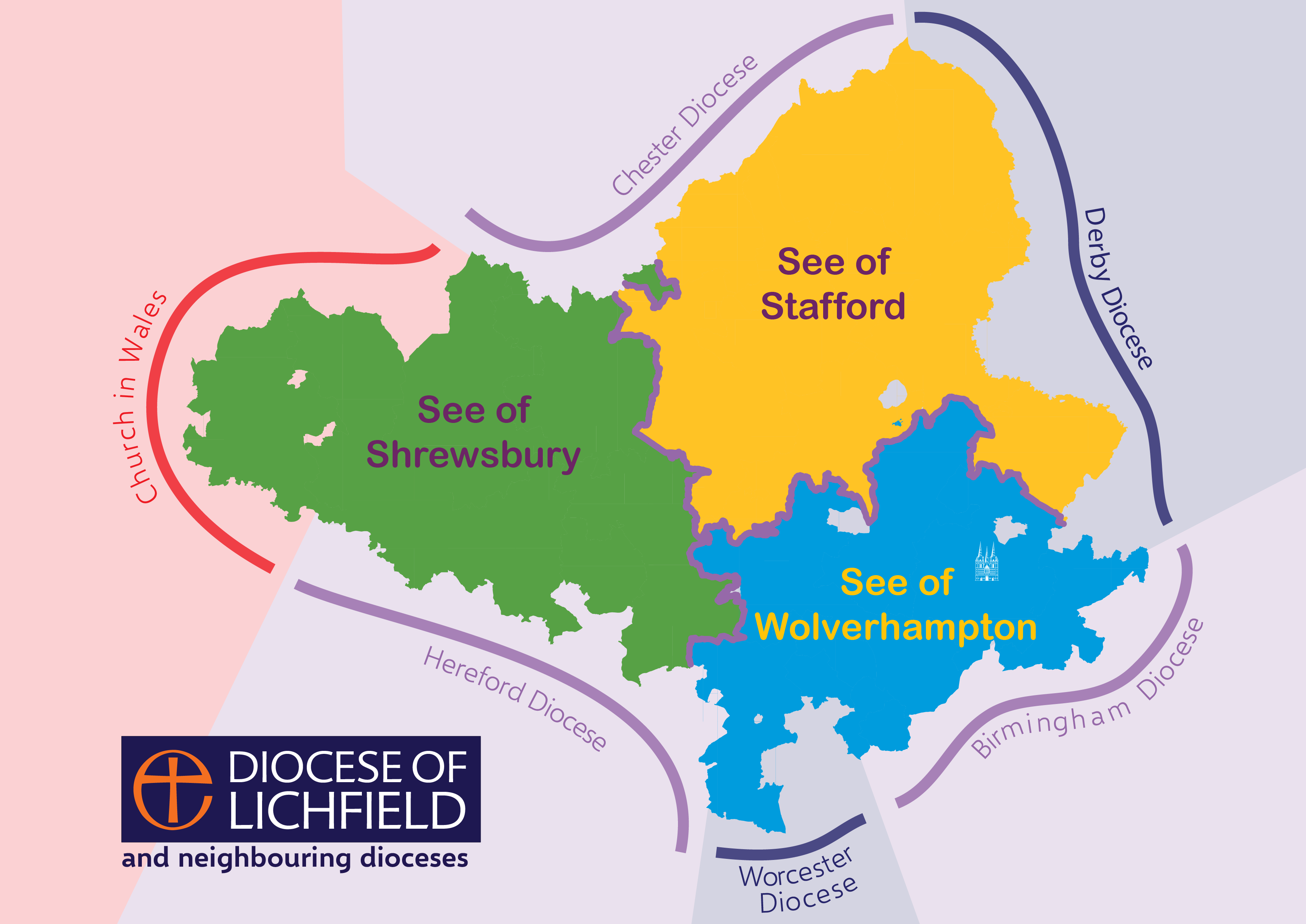
The diocese today comprises 1730 square miles of northern Shropshire, Staffordshire and The Black Country. The ancient boundaries would have been those of the Kingdom of Mercia when it stretched from Preston to Coventry. Four bishops were based at Repton near Derby until Chad succeeded them. He moved the base of the diocese to Lichfield when in 669 AD he became the first Bishop of Lichfield.
As the diocese grew it spawned many dioceses – from Blackburn through Manchester, Liverpool, Chester, Derby, Leicester, and Birmingham.
Chad was a monk from Northumbria, part of the early British, Celtic church and his successors were variously known as Bishop of Lichfield, of Chester, of Coventry, of Coventry and Lichfield, of Lichfield and Coventry. For a brief period, Hygbert was Archbishop of Lichfield in the Province of Mercia. The 90th Bishop, George Selwyn, translated from New Zealand, is among more recent bishops of Lichfield still celebrated today.
Lichfield Diocese today
Population and Church
Population and civic life
Rapid population growth started with the industrial revolution, resulting in the rapid proliferation of parishes that we recognise today. Staffordshire became known as the home of the Potteries and the Black Country was named because of the pollution from coal mines, iron works and forges. There is still significant but smaller scale and more specialist craft and industry in the whole diocese.
Population (2024): 2,202,000 souls, the 7th most populous diocese in the Church of England, but the 2nd largest by population excluding those with metropolitan areas. Just under half called themselves Christian in the 2021 Census.
The average population density across the whole diocese is 1270 people per square mile, mid-point among other dioceses, but this doesn’t tell the whole story: Shropshire’s population density at 270 p/sq mi. is nearly the least dense district of England and Sandwell at 10,700 and Wolverhampton at 10,500 p/sq mi. are near the top of the table adjacent to Birmingham and where London boroughs all have densities of 11000 p/sq mi. up to 40,000.
 Lichfield Diocese interacts with many local authorities: Shropshire and Staffordshire county councils, Telford & Wrekin, Sandwell, Wolverhampton, Walsall and Stoke-on-Trent are the main ones, but we also intersect with slithers of Worcestershire, Leicestershire and others.
Lichfield Diocese contains more Football League clubs than any diocese other than London: Shrewsbury Town, Wolverhampton Wanderers, West Bromwich Albion, Walsall, Burton Albion, Stoke City and Port Vale.
Of more ministerial significance, given the greater number of prison chaplains compared to football ones, is that Lichfield Diocese is also home to more prisons than any other diocese. Brinsford Young Offender Institution and Remand Centre, Dovegate Prison, Drake Hall Prison and Young Offender Institution, Featherstone Prison, Oakwood Prison, Stafford Prison, Stoke Heath Young Offender Institution, Swinfen Hall Prison and Young Offender Institution, Werrington Young Offender Institution
 Church life
The current Bishop of Lichfield shares episcopal ministry in an area bishop scheme where some of the diocesan bishop’s duties are delegated to suffragans in the areas. Lichfield Diocese has four areas: Lichfield, Shrewsbury, Wolverhampton and Stafford. The bishops are in turn supported by four archdeacons for the archdeaconries of Salop, Walsall, Stoke-upon-Trent and Lichfield.
Worshipping Community
There are 27 deaneries containing a total worshipping community of 34,800 (Statistics for Mission, 2024).
| Benefices | Parishes | Churches |
| 230 | 422 | 540 |
Average Weekly Attendance
| All-age: | 21,200 |
| Child: | 2,600 |
Finance
Parishes had a turnover of nearly £29m in 2024, including grants, legacies and gift aid recovered on giving. Forty per cent of that came from giving by members and visitors, a quarter through sources such as hiring out church halls and the remainder in one-off payments including things like wedding and funeral fees.
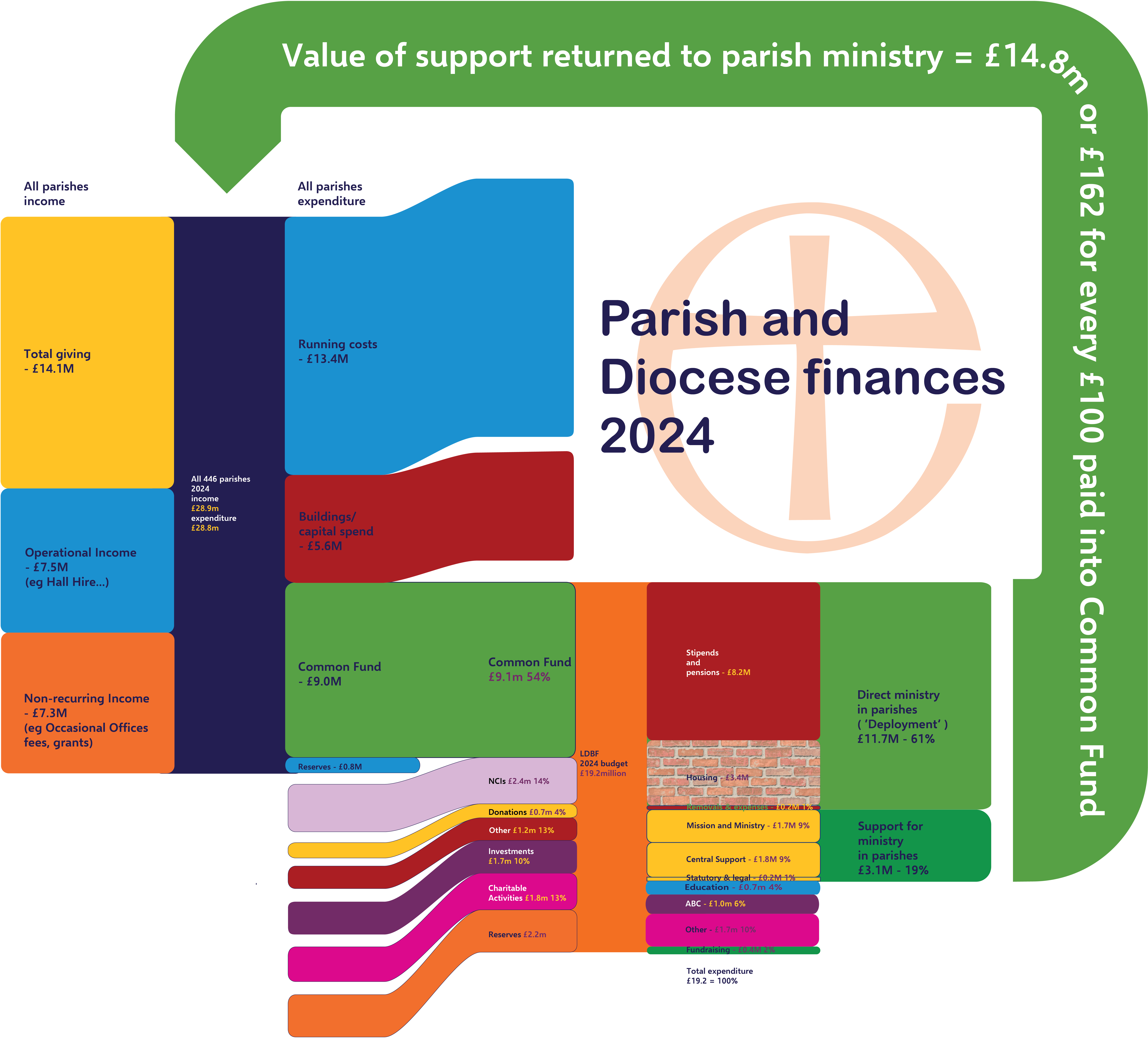
As well as paying for their running costs and day-to-day building maintenance, parishes’ £29m income contributed £9m into the Common Fund, which directly funds their clergy and more. The Common Fund also funds many support services to parishes: archdeacons, safeguarding, finance, communications and the DAC (the free-at-point-of-use Church of England equivalent of planning permission). Funding for these is beyond the parish share and currently comes from grant and other funding as well as drawing to some extent on reserves.
There are signs of financial health in the diocese:
- Parishes have found more money in cash terms for their buildings in recent years. Capital expenditure on buildings is back to the pre-pandemic peak of £5 million a year.
- Grant income in 2024 rose to closely track and almost equal the level of capital expenditure 2022-2024, a sea-change on a decade ago.
- Total income rose slightly from 2022-2024 in cash terms, though it is still lower than pre-pandemic.
- Caution: giving income is sustained by fewer people giving more and the increase is in interest, property income (church halls, parish houses), dividends and anything else.
- Most noteworthy though, is the commitment among parishes, evidenced in consultations in episcopal areas last year, to becoming financially sustainable through growing the number of worshippers and givers where there is realistic hope and scope for that.
- A hopeful token is that there were more than 7.4 million instances of our parishes begin searched for on achurchnearyou.com, which carries details for every parish making Lichfield the diocese with the fifth highest number of searches.